Your First Lesson Outside: A 30-Minute Plan That Won't Fall Apart
Don't start with the big unit. Start with one lesson that is almost impossible to lose control of, then build from there.
Most first outdoor lessons fail for one reason: the teacher tries to teach the same lesson they would have taught inside, just with more sky. The kids feel the difference immediately. The room has no walls, the rules feel optional, and twenty minutes later you're back at your desk deciding never to do that again.
The fix is not more rules. It's picking a first lesson that uses the outdoors instead of tolerating it, and setting three things up before you walk out the door.
Before you go: three things, ten minutes
1. Tell the office and pick a boundary
Send a two-line email to the front office with the time and location. Then walk the space and pick a boundary you can describe in one sentence: “Stay between the big tree and the fence, and I always need to be able to see you.” Point at it when you get there. Have two students repeat it back.
2. Choose a gather signal
Not your voice. A whistle, a clap pattern, a raised hand with a countdown; anything that works from forty feet away. Practice it once inside. Practice it once more the moment you step outside, before anything else happens.
3. Give everyone a job
Outdoor chaos is almost always a student with nothing to hold. A clipboard, a magnifier, a container, a “finder” role for a partner. If every student has an object and a task, you have a class, not a crowd.
The whole plan fits on one page
The observation-walk lesson below, the boundary sentence, the signal, and the jobs are all on a single printable sheet in the free Starter Kit. Print it, put it on the clipboard, walk out the door.
The lesson: “Same, different, why” (30 minutes)
This is a structured observation walk. It works from kindergarten to eighth grade because the thinking scales and the logistics don't.
- Gather and frame (3 min). Boundary, signal, jobs. Then the task: “Find two living things that are the same in one way and different in another. Draw or write both. Be ready to say why you think they're different.”
- Explore in pairs (12 min). Partners stay within arm's reach of each other. You circulate the perimeter, not the middle; from the edge you can see everyone. Use the signal once at the halfway point just to prove it works. Release them again immediately.
- Gather and share (10 min). Sit in a circle on the ground or a curb. Three pairs share. Push on the “why” each time: “Why do you think the leaves on the shady side are bigger?” Don't answer; collect their claims on the clipboard.
- Close (5 min). One sentence each, whip-around: “Something I noticed outside that I never noticed before.” Line up on the signal. Back inside, the claims go on the board for tomorrow.
Your quietest kids will talk out here. Almost every teacher reports the same thing after the first walk, and it never stops being surprising.
When it goes sideways
- Someone runs past the boundary. Signal, everyone freezes, you restate the boundary, everyone goes back to work. Ninety seconds. Don't lecture the group for one student.
- Half the class is “done” in four minutes. Give the extension in advance: “When you have two, find a third that doesn't fit either group.”
- A dog, a lawn mower, a bee. Use the signal, move the boundary, keep going. The class learns that you have a plan, which is the whole point of a first lesson.
Does it count?
Yes. Write it on the board like you would anything else. The lesson lands on asking questions and constructing explanations (NGSS science and engineering practices), on speaking and listening standards at every grade, and, if you have them draw to scale, on measurement. The Starter Kit includes the crosswalk for K–2, 3–5, and 6–8.
Get the one-page plan
The printable version of this lesson, plus four more, the routine card, and the permission letter. Free.
Next week
Run the exact same lesson again with a different prompt (“Find two things that are changing”). Same boundary, same signal, same jobs. The second time is when the routines stick, and after that you can start bringing the curriculum outside instead of a lesson about being outside.
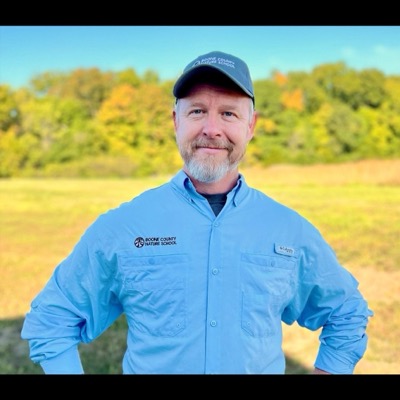
Joe Brown
Science teacher for 20+ years. First teacher at the Boone County Nature School. Founder of Outside Edu. More about Joe →
Science teacher for 20+ years. First teacher at the Boone County Nature School. Founder of Outside Edu. More about Joe →